
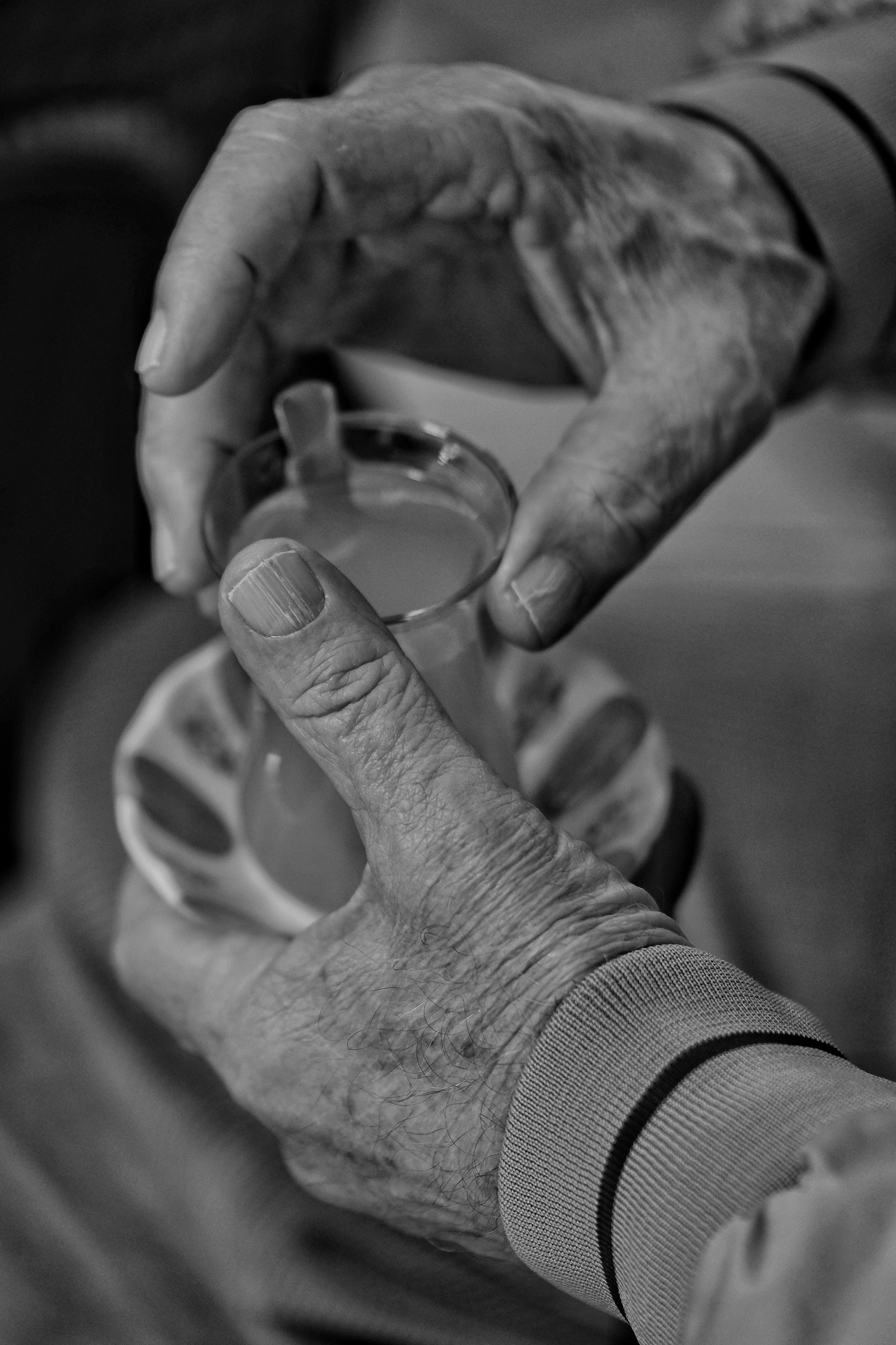
The family calls. The parent says they're fine. And everyone keeps going.
Photo credit Önder Ceneviz
Early in my career, I worked in a retail bank branch in India. Every day, between noon and 3pm, the same thing happened. Elderly retired customers would come in, sit down with the branch staff, and talk. About their accounts, mostly. Accounts that didn't have much in them, and nothing urgent to discuss.
They weren't there for the banking. They were there for the branch. The noise, the movement, the sense of being somewhere that mattered. They'd found a place where showing up had a purpose, even if the purpose was invented.
I've thought about that a lot lately. I see the same instinct in my aging uncles in India. I see it in aging adults across countries, gravitating toward shopping malls the way an earlier generation gravitated toward town squares. And I heard it just yesterday, in a conversation with a home care agency leader in New York City. He told me they'd just opened a coffee lounge in their office. For the elderly clients. Same reason: human connection. A place to belong.
The people around these elders are paying attention. They notice who's quieter than usual. Who's eating less. Whose eyes light up when someone sits with them and whose don't.
The family living 8,000 miles away misses all of this.
There's an acronym used in elder care circles: PICA. Parents in India, Children Abroad. But the geography is bigger than that. It's parents in Manila and children in Toronto. Parents in Guangzhou and children in San Francisco. Parents in Lagos, in Mexico City, in Melbourne, and children building careers and raising families on the other side of the world.
Tens of millions of first-generation immigrants made that choice. Their parents are now in their seventies and eighties. Research from India's Longitudinal Ageing Study found that 36% of older parents have at least one child living outside their district, state, or country. Among those parents, rates of depression and poor self-rated health are significantly higher. This isn't a cultural problem or a moral failure. It's a structural one.
In the US, the aging immigrant population is one of the fastest-growing demographic shifts in elder care. The number of immigrants aged 60 and older is expected to reach 20 million by 2050, up from around 3 million in 1990. Many followed their children here. Many are navigating a healthcare system that wasn't built with them in mind. All of them will need care. Most will rely on home care.
And here's where the invisible caregiver meets an invisible wall.
Home care agencies are doing the best they can. Their aides show up, do the work, and notice things. An elder who hasn't touched her lunch. A shift that felt heavier than usual. A question that didn't get asked. But none of that observation has a clear path forward. It doesn't feel like an incident. It isn't alarming enough to escalate. So it stays in the room. The aide finishes the shift, moves to the next family, and the moment passes.
The family calls. The parent says they're fine. And everyone keeps going.
This is not a failure of people. The aides are doing their job with genuine care. The agencies are managing real operational complexity. Home care caregiver turnover runs at 75% nationally. Client churn sits slightly north of 45%. Both trace back to the same root cause: small things go unconnected between visits, and by the time someone finds out, trust has already eroded.
What's missing isn't care. It's the connection between what gets noticed in the room and what reaches the family waiting for news. The aide sees it. The agency doesn't know. The family never finds out. Everyone is doing their job. The gap is in between.
CuroNow was built to close that gap. Not to replace the humans in the system, but to give them a shared way to see what's happening between visits, before the small things become the thing nobody saw coming.
The bank branch customers knew something. Loneliness announces itself. It walks in every day at noon and sits down and pretends to check its balance.
The question isn't whether the signals exist. They do. The question is who gets to see them, and whether the family 8,000 miles away is ever one of them.
Rukmini
Founder & CEO, CuroNow
