
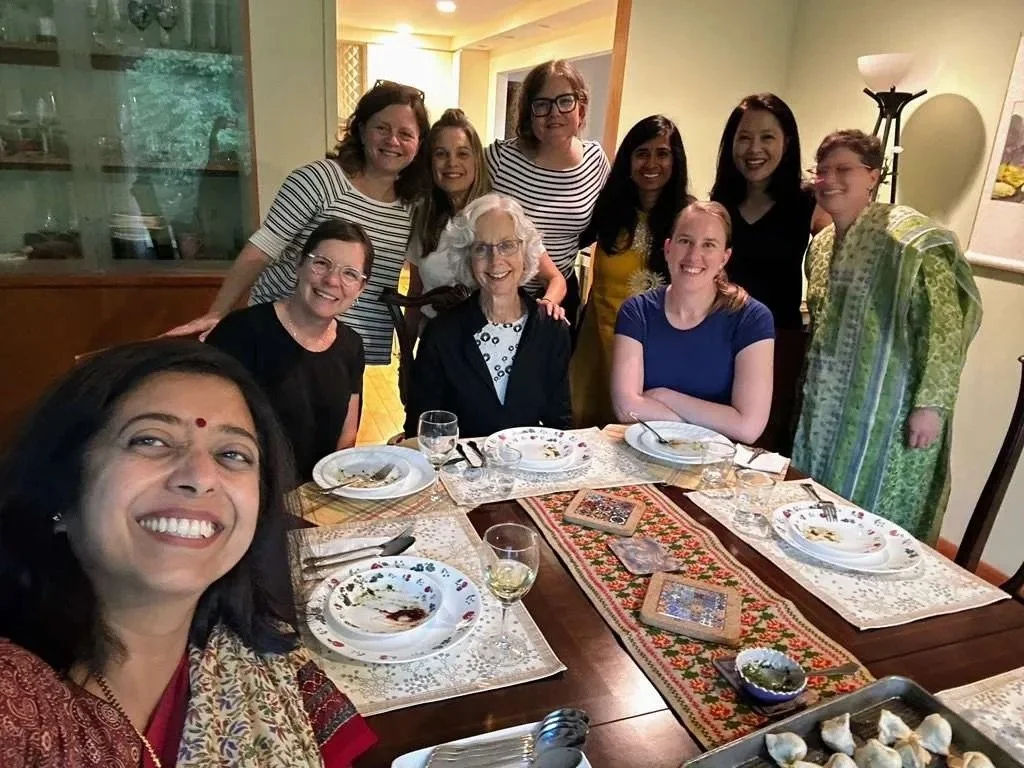
Our Care Circle at Rukmini’s Bengali Dinner — a night of laughter, shared stories, and connection that continues to remind us why we started this journey.
Reimagining “family” through friendship, trust, and collective care
A year ago, my neighbor Rachel spotted me walking down our street. What she didn’t realize at first was that it was me — I looked so different after my surgery and long recovery from Cushing’s disease. We chatted for just a moment, and later she reached out and invited me for a walk. She had an idea she wanted to share.
During that walk, she asked a question that would quietly change both of our lives:
“Did you ever wish you could call on a neighbor to do things for you — and would that have been helpful?”
The answer, of course, was yes. During recovery, I had needed so much help — with errands, meals, encouragement — but I didn’t always know how to ask. That simple question became the seed for something much bigger: what if we created a small group of women who met regularly, built friendships, and learned to support one another long before any of us actually needed caregiving help?
Rachel, with the kind of compassion that comes naturally to a retired physician and all-around good neighbor, had recently read an interview with author and former caregiver Emily Kenway in The Sun Magazine, called Home Sick. Kenway’s work — especially her essay To Solve the Care Crisis, Reimagine “Family” — challenges the idea that care only belongs within biological families. She writes about building “families of choice” and practicing kinning — forming bonds of care and trust outside traditional family structures. The idea struck both of us deeply, so we decided to give it a try.
The Invitation
We each invited a few people we thought might say yes — women we admired, barely knew, or simply sensed might be craving connection too. Then we sent a short note to the group, introducing the idea:
“Hi! You are getting this email because you’ve told either Rachel or Pat that you’re willing to give a new idea a chance. Thank you! 🤩
We’ve gathered a group of eleven loosely affiliated women of various ages to join this venture. The only thing connecting you right now is that someone in the group thought you’d enjoy it.
It’s called a Collective Care Circle, or CCC. The idea isn’t to be caregivers for each other, but to meet monthly to form friendships that are valuable on their own and will sustain us when we need support.”
We didn’t have a detailed plan — just curiosity and a willingness to show up.
Creating Our Charter
At that first meeting, we created a simple charter — a few shared ground rules to keep things easy and welcoming. We agreed that there was no need to bring food or snacks; hosts would simply offer water or tea so no one felt pressured to go all out. The goal was connection, not performance.
We also decided to meet monthly and take turns hosting, but beyond that, everything would evolve naturally. That low-pressure start has been a big reason it’s worked so well — it keeps our focus on people, not logistics.
The Circle Comes to Life
In the early months, most of our gatherings were at Rachel’s or my house. We’d sit in a circle, share updates, and slowly get to know one another. Co-hosting those first few sessions was a stretch for me — not just because I don’t love being the center of attention, but because it was the first time I had really shared my healthcare journey aloud. Opening up brought an instant closeness to the group.
Since then, our gatherings have taken on a life of their own. One of our members hosted us for a Sukkot circle outdoors under a tent, with beautiful string lights twinkling above us as fall settled in. Rukmini welcomed everyone into her home for an incredible Bengali dinner — several of us even dressed for the occasion, and the photo from that night still makes me smile. One evening we walked to the Chocolate Shoppe, our favorite local ice-cream spot — only half of us got a cone (some had more willpower than others!). Over the summer, we met at the UW Memorial Union, sharing fries and cheese curds, watching the sunset over Lake Mendota. Next up? A haunted tour of Madison in October.
We’ve even done a few things off-cycle — volunteering, canvassing, and showing up at local events together. What started as a simple experiment has turned into something we all look forward to each month. I often find myself checking my calendar to see how many days are left until the next one.
What It’s Taught Me
Every time we meet, I’m reminded that care is something we can practice before we need it. It’s in the laughter, the small check-ins, the follow-up text that says, “Just thinking of you.” It’s not about grand gestures — it’s about community built one conversation at a time.
For me, this circle has been one of the most meaningful parts of recovery and reconnection. It’s taught me that leading can be quiet — about creating space for others to feel seen and heard. And it’s shown me that even among people with very different backgrounds, ages, and beliefs, real connection is possible when we come together with shared intent.
From Circles to Systems
That same spirit is what we’re building at CuroNow. Both Rukmini and I are part of this mission now — though this circle actually began before I joined her on the CuroNow venture. Back then, she even presented our concept alongside the friend she invited to the circle who helped her launch the project in its first few months — and that same friend is part of our care circle too.
Looking back, it’s clear: what we’ve created together is at the heart of who we are as co-founders. CuroNow was built to find joy in connection — to help families, friends, and chosen circles organize care proactively, before an emergency happens. It’s about recognizing that care isn’t just about logistics; it’s about belonging.
Our circle may have started as a neighborhood experiment, but it’s become a living example of what’s possible when we choose to build community on purpose.
Thinking of Starting Your Own?
If this idea sparks something for you — start small. Invite a few friends, neighbors, or colleagues who might be open to connection. Set a few ground rules that make it easy (no cooking required!), and meet regularly. You might be surprised, like we were, by how quickly those conversations turn into something much deeper.
Because care doesn’t have to start with crisis. Sometimes it starts with a walk down the street, a compassionate neighbor, and a question that opens the door to something extraordinary.
(And occasionally, sharing ice cream and cheese curds while we’re at it.)
Here's to connection amongst friends and neighbors,
Pat
Co-Founder, CuroNow
Supporting Caregivers. Strengthening Connections.